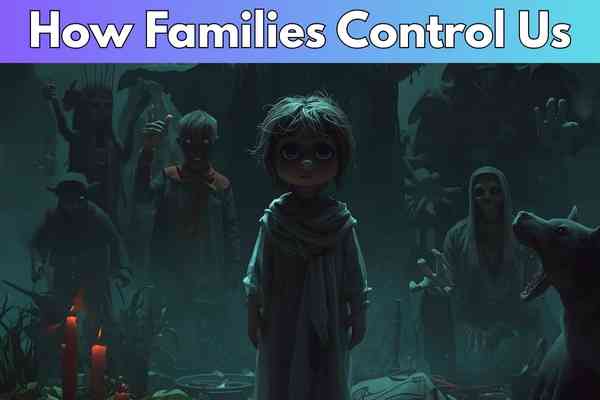
How Families Control Us
Introduction
Every family has secrets.
Some are small—a forgotten story, an unspoken disagreement.
Others are heavier: hidden traumas, silences around addiction, betrayals never acknowledged.
What’s striking is that these secrets often shape our lives more than what is openly discussed.
Running on Rules
Families, like societies, run on rules.
Some rules are spoken, but many are unspoken.
A child learns early when to stay silent, when to smile, and which topics are off-limits.
Over time, these unspoken lessons become a script—an invisible map of behavior carried into adulthood.
Take the child of a family where financial struggles were never discussed.
They may grow up with an unconscious belief that money is taboo, leading to avoidance or anxiety in their own financial life.
Or consider a family where one parent’s addiction was silently tolerated.
The children may inherit roles—caretaker, scapegoat, hero—without ever choosing them.
The Hidden Scripts
These hidden scripts aren’t random.
They operate like subplots in a screenplay, quietly driving character development.
Silence in a family is rarely empty; it’s full of meaning.
The danger is that these stories replicate themselves across generations.
A secret about a grandparent’s trauma might manifest as unexplained anxiety in a grandchild.
The unspoken becomes destiny—unless someone chooses to speak.
Conclusion
That’s the power of narrative awareness.
By recognizing the hidden scripts we’ve inherited, we can step outside them.
We can ask:
Is this my role or my family’s?
Do I continue the story or rewrite it?
Secrets don’t just hide the past; they shape the present.
And awareness is the first step toward freedom.
Key Takeaways
Family secrets create unspoken scripts that guide behavior across generations.
Silence often carries more influence than words in shaping identity.
Recognizing hidden scripts allows us to break cycles and rewrite our roles.
